Training & Technical Assistance Program to Center Racial Equity in Data Integration
Cross-sector data sharing and integration can transform data about individuals into actionable information that can be used to build stronger, healthier and more just communities. At the same time, cross-sector data can reinforce legacies of racist policies and lead to inequitable resource allocation, access, and outcomes.
AISP’s Equity in Practice Learning Community is designed to help data sharing efforts implement and build on the promising practices identified in our Toolkit for Centering Racial Equity in Data Integration. Together, we aim to create a new kind of data infrastructure that shares power and knowledge with communities.
EiPLC Sites | Cohort 2 | Education Equity
The second EiPLC cohort ran from May 2023 – October 2025 and was made up of four sites. Through collaboration with each other and AISP, they worked to build, test, and implement new models for incorporating community voice and racial equity in key decisions about cross-sector data use. We are excited to see how their progress will move our field forward.
The California Cradle-to-Career Data System (C2C) participated in Cohort 2 with a primary focus of increasing community engagement and elevating community voice to inform the development and analysis of their data. C2C joined the cohort with an already robust governance structure including a governing board and two advisory committees, all of which hold public meetings.
During their time in EiPLC, C2C has launched a multitude of initiatives, including their Student Pathways Data Story, which is a tool that allows users to explore California student’s transitions from high school graduation to California colleges and into the workforce. They also launched their Lesson Plan Challenge, inviting educators to build out lesson plans using the Student Pathways Data Story to engage students directly and foster a network of data-driven educators across the state. Learn more about C2C and their work here.
Four entities from the Salt Lake City region (Promise Partnership Utah, Promise South Salt Lake, Millcreek Promise, and Granite School District) partnered together to participate in Cohort 2. The team worked on building trust and participatory data governance to strengthen their ability to share information towards a shared goal: that 100% of South Salt Lake and Millcreek students have basic needs met and graduate on a career path.
During their time in EiPLC, the team incorporated feedback from parents into new, more accessible, consent forms; created a new DSA to guide data exchange; conducted focus groups with youth to identify ways their school and community can support them on their path to graduation; and created a toolkit for members of the Promise Partnership. Moving forward, the partnership will be using the findings from the focus groups to create a mural, and host a community art event to celebrate its completion. Learn more about Promise Partnership and their work here.
San Francisco Unified School District (SFUSD) and the City’s Department of Children, Youth, and Families (DCYF) participated in Cohort 2 with the goal of establishing governance for and increasing the impact of their joint effort, SF Youth Data Bridge. The Youth Data Bridge connects information about students served by the District and DCYF-funded community based organizations (CBOs) both in and out of school.
The team first sought feedback from CBOs working in San Francisco’s Community Schools on their data needs and created a data sharing toolkit to answer common questions related to data sharing, consent and permissible uses of student data. They also created a new data dashboard tool for CBOs to use for planning, program evaluation, and reporting similar to what is already available to district staff, and will provide access to credentialed users who have attended a companion training session. Finally, the team was able to connect with the District’s existing Student Success Fund advisory board and invite that group, which includes parent and youth representatives, to help guide the Youth Data Bridge going forward. Learn more about their work here.
Generation Next, Northside Achievement Zone (NAZ), Saint Paul Promise (SPP), and Wilder Research participated in Cohort 2 to develop intentional processes to share data with communities represented in their Minneapolis and Saint Paul (MSP) Education Equity Data Hub, a place-based collective impact approach to supporting students in the Twin Cities. During their time in EiPLC, the team brokered access to expanded MN SLEDS data and developed a statement of purpose and shared commitments. They also hosted meaning-making sessions where community participants had the opportunity to explore existing data and identify new questions the data hub can help answer to better support students and families.
The team plans to host more meaning-making sessions and has begun outlining a community advisory board structure that will support MSP Education Equity Data Hub data governance processes. Learn more about the MSP Education Equity Hub and their work here.
EiPLC Sites | Cohort 1 | Health Equity
The first EiPLC cohort ran from May 2022 to November 2024 and was made up of two mentor sites and four mentee sites. Through collaboration with each other and AISP, they worked to build, test, and implement new models for incorporating community voice and racial equity in key decisions about cross-sector data use. We are excited to see how their progress will move our field forward.
Baltimore’s Promise served as a Cohort 1 mentor site. The team, which includes education, workforce, housing and youth-serving nonprofit partners, focuses on increasing youth decision-making in the Baltimore City Youth Data Hub governance structure, as well as supporting other cohort sites with training and consultation throughout the learning community. Working alongside Baltimore City Schools and Baltimore City Government, Baltimore’s Promise recruited 14 community members with diverse lived experience to form a new Community Research and Advisory Committee (C-RAC) in 2024. With facilitation support from Two Gems Consulting Services, the team also hosted four engagement sessions with a combined 200 community participants to gather feedback as they launched their first data projects. Both of these strategies, broad public engagement and sustained, deep collaboration with C-RAC, will continue to guide the Baltimore City Youth Data Hub as they move forward. Learn more about the Baltimore City Youth Data Hub and their work here.
The Children’s Services Council (CSC) of Broward County, Florida served as a Cohort 1 mentor site. The team, which includes child welfare, juvenile justice, school district, and mental health partners, worked to center community voice in the governance and use of the Broward Data Collaborative, as well as support other cohort sites along their journey. CSC Broward shared lessons from years of community participatory action research (CPAR), youth organizing with system professionals, as well as, prior to 2022, extensive training for partners and staff on the local history of racism and implicit bias.
Through the EiPLC, CSC Broward conducted a new CPAR project in 2023 focused on understanding the impacts of being “Baker Acted,” a term used to describe the experience of involuntary admission to a hospital for a mental health crisis in Florida. The 2023 CPAR project brought together youth and parents of children who have experienced being “Baker Acted” and mental health professionals as co-researchers. They created resources aimed to support families through the Baker Act process and hosted focus groups to better understand what policy changes could improve the experience for youth and families. One CPAR finding has already had an impact; in 2024, Broward County has committed to funding a transportation pilot for an ambulance transport when appropriate rather than law enforcement transport, as many youth had reported their transport experiences were criminalizing and traumatizing. Finally, to bring this work to a wider audience, the team partnered with What’s Your Elephant to translate the project findings into an interactive arts exhibit called Echoes of Empathy in Summer 2024. Learn more about their work here.
The Charlotte Regional Data Trust (Data Trust), the City of Charlotte, and Mecklenburg County Criminal Justice Services participated in Cohort 1, with a primary focus on team formation and the creation of a Community Data Advisory Committee (CDAC). The vision of the CDAC is to create intentional and formal processes to share oversight of Data Trust data with people whose experiences are represented in the data. This practice integrates community expertise and insight across the data lifecycle, helping to ensure ethical use, accurate interpretation, and actionable dissemination. The team used community participation funds from EiPLC to compensate committee members and a trained facilitator for CDAC. In the future, the Charlotte-Mecklenburg team hopes to hold a series of “mixers” to bring together data users, data creators, and community members interested in using the Data Trust with a focus on equity. Learn more about their work here.
The Connecticut Office of Policy & Management, alongside partners from the Office of Health Strategy and the Department of Social Services, joined Cohort 1 to center racial equity and community voice in the governance and use of the state’s P20 WIN longitudinal data system, All-Payers Claim Database, and other cross-agency data assets. Together, they improved their collection and reporting of standardized race, ethnicity, language, and disability (REL-D) data with the development of an implementation toolkit for statewide standards. The standards are in a granular format to enable interest-holders to identify disparities in service delivery and make strides toward a more equitable health system, and are now published annually in order to capture changing needs over time. The team also co-created and disseminated new guidance documents for state agencies, such as the Data Protection, Privacy + Equity Impact Assessment (DPPEIA), Equity Awareness in Data Reporting, and Data Visualization and Accessibility Guidelines, to support implementation of equity practices. With each new process, the team has developed stronger relationships and increased transparency of data practices across the state. Learn more about their work here.
The King County Department of Community and Human Services and Public Health Seattle-King County joined Cohort 1 to center racial equity and community voice in the governance and use of their Integrated Data Hub. This involved working closely with key partners at the King County Office of Equity and Social Justice and broader provider networks. The King County team dedicated substantial time to planning for intentional engagement with community-based organizations (CBOs) that collect and share client-level data with the County. They then convened a series of meetings with the CBOs to deepen their shared understanding of collection, use, and integration of client-level data. These conversations explored their different data landscapes and questions of how best to responsibly share and use data while improving accountability between clients, data partners, and the County. The County is moving forward in partnership with participating organizations to develop new informational resources that explain how it collects, protects, and uses data to provide better services to our community.
The team also spent time delving into the policy histories of 5 key topic areas— behavioral health, disability justice, housing and homelessness, incarceration and the criminal legal system, and data and evaluation as a practice— to document context and equity considerations. Analysts from across the department collaborated to create a highly visual and adaptable internal resource on these histories which will continue to be used to support staff onboarding and team values alignment going forward.
Oregon’s Enterprise Information Services’ Office of Data Governance and Transparency, and the Center for Evidence-based Policy at Oregon Health & Science University (OHSU) joined Cohort 1 to work on two complementary efforts to center racial equity and community voice in Oregon’s use of data. The team at OHSU manages the Oregon Child Integrated Dataset (OCID), a non-partisan project that brings together data from education, health, social service, juvenile justice, and early learning programs to inform state policy. The OCID team developed a framework based on AISP’s data lifecycle model to guide equity and engagement considerations throughout the phases of OCID analyses, and to set goals in both areas. They used Community Participation funds to support staff training from We All Count, as well as convene specialized advisory panels to inform proposed analysis and methods considerations in the future. Learn more about their work here.
Oregon’s Chief Data Officer and other team members from the Enterprise Information Services’ Office of Data Governance and Transparency also participated in the learning community, building on efforts to address systemic inequities through data integration projects and initiatives, as included in Oregon’s Data Strategy. They are currently working to develop enterprise level data governance alongside a core group of state partners. Learn more about their work here.
EiPLC Equity Fellows
AISP’s Equity Fellows are both our advisors for this initiative and play an essential role in supporting site learning and growth. Fellows work with AISP to help participating sites analyze how institutional and structural racism impacts day-to-day data access and use practices, and identify ways to shift practice. The work includes racial equity training, an equity audit tool, the co-creation and implementation of a plan to incorporate community voice into the site-based data governance, and the completion of an integrated data use case that originates from the community. These six awesome humans bring diverse perspectives and decades of experience to this role.
Bridget Blount is the Chief Impact Officer with Baltimore’s Promise where she directs data analysis, evaluation, and the Baltimore Youth Data Hub. The Hub brings communities, providers, policymakers, and researchers into partnership to make informed decisions as they work to eliminate disparities and achieve equitable outcomes for Baltimore’s youth and families. Before joining Baltimore’s Promise in 2018, Bridget served as the Director of Data and Evaluation for the Family League of Baltimore City, where she led the development of two citywide management information systems to collect data from diverse summer program providers and prenatal home visiting programs. Bridget is passionate about helping nonprofits harness the power of data to strengthen their organizations, improve their services, and communicate their impact.
Bridget serves as an EiPLC Cohort 1 Fellow.
Sue Gallagher, EdD, is the Chief Innovation Officer at the Children’s Services Council of Broward County, FL. She brings over 30 years of local government and non-profit experience to her role as an AISP Equity Fellow. With local partners and colleagues, Sue co-created the Broward Data Collaborative in 2017. The Collaborative’s innovative approach to data sharing has included a focus on community participatory action research, youth priorities, and extensive training for partners and staff on the local history of racism and implicit bias. Sue is excited about the opportunity to help expand deep, equitable community participation in data infrastructure and use.
Sue serves as an EiPLC Cohort 1 Fellow

Robert Gradeck has 25 years of professional experience helping people find and use civic information. He manages and co-founded the Western Pennsylvania Regional Data Center (WPRDC) at the University of Pittsburgh. The WPRDC is an inclusive open data partnership between the University, Allegheny County, and the City of Pittsburgh. The WPRDC helps to inform many community initiatives in the areas of health, housing, environmental protection, transportation, and social justice. He is a member of the Civic Switchboard project, which helps libraries and library workers become participants in civic data initiatives, and participates in the National Neighborhood Indicators Partnership. Robert is also currently a co-leader of the Black Equity Coalition’s Data Justice Working Group. He received his B.A. in Urban Studies from the University of Pittsburgh, and Masters in City Planning from the Georgia Institute of Technology.
Bob serves as an EiPLC Cohort 2 Fellow.

Blu Lewis—originally from Harlem, NY—is passionate about honoring Black Radical Traditions and building infrastructure that can shift the conditions for Black people and movements. They have over ten years of experience as a community organizer, researcher, program director, and creator of popular education curriculum. In their current work, Blu focuses on coordinating, aligning, and developing Black & POC membership-led movements centered on meeting the needs and shifting the conditions of Black communities and dismantling data capitalism. Blu resides in Charlotte, NC and is a Community Participatory Researcher for the Our Data Bodies research collective, Organizing Director of NC BLOC, and Minister of Organizing for the Movement for Black Lives.
Blu serves as an EiPLC Cohort 1 Fellow.

Kim Paull believes that we are not slices of data; we are whole human beings, raised in families, rooted in communities, bearing our history. And our data systems, culture, and context must honor that complexity. Kim has worked for over a decade in public service as a government analytics leader. Most recently, Kim led the creation of an integrated data system and holistic data culture for Rhode Island’s health and human services agencies. She is now the Director of the Health Equity Clinical Program for Blue Cross Blue Shield of Rhode Island. She lives in Rhode Island with her wife and twin girls.
Kim serves as an EiPLC Cohort 1 Fellow.
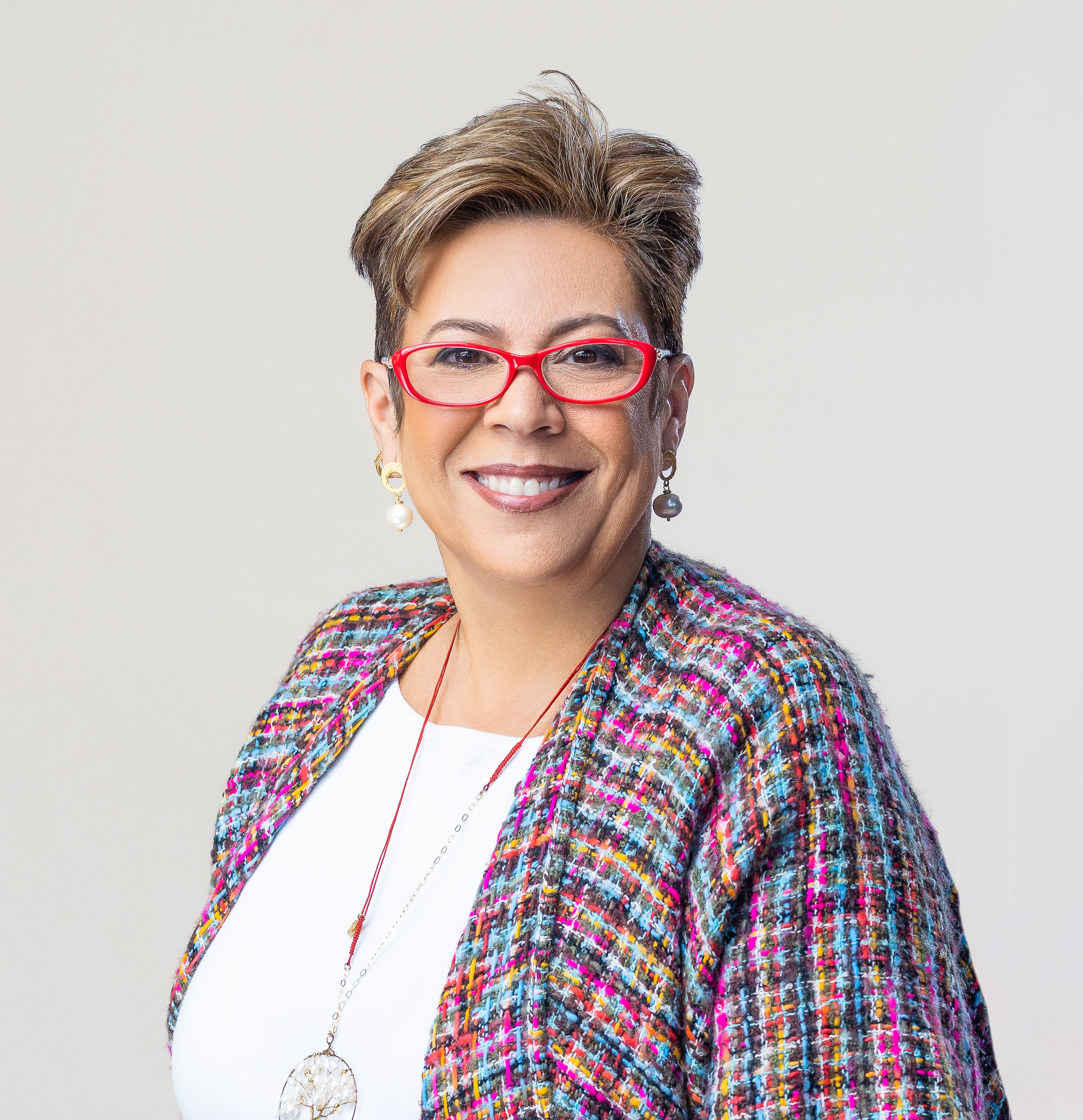
Enid M. Rey, ESQ. has twenty years of innovative, visionary leadership and achievement in the philanthropic, legal, government and non-profit sectors. She is a nationally recognized advocate and speaker in the fields of family support, positive youth development, and school integration efforts. As a skilled advocate for children, youth and families, Enid’s success is in bridging policy, protocols, process, and quality practice to affect change in the outcomes for youth and families. Fluent in Spanish and English, with extensive public speaking and media-relations experience, her work in education was featured in the 2015 This American Life episode on school integration, “The Problem We All Live With.” Throughout her career she has developed a unique vantage point that enables her to connect systems change work and grass roots community capacity building efforts. Her work is centered on the values and belief that youth and families are resident experts in their conditions and have the knowledge and capacity needed to build transformative action for their own communities.
Enid serves an an EiPLC Cohort 2 Fellow.


